
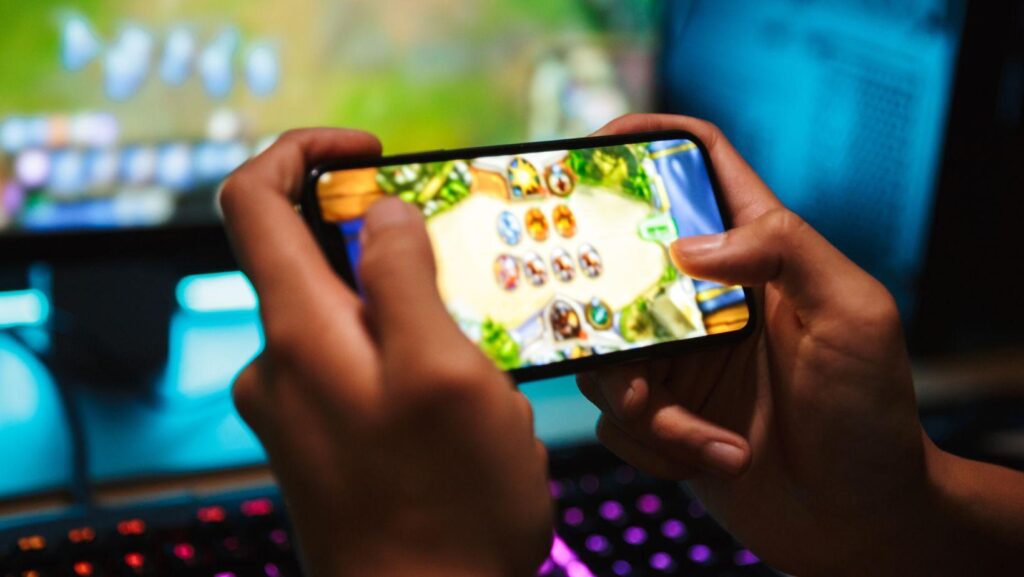
The global mobile gaming landscape has shifted from a minor distraction into a massive digital ecosystem. Industry data shows the global mobile gaming market will reach $158.50 billion in 2026. This massive footprint accounts for nearly 60% of all interactive entertainment earnings across the globe.
Technical Advances in Modern Touch Sensors
The seamless feel of dragging a thumb across a screen to aim a weapon or guide a car depends entirely on hardware physics. Older mobile devices often relied on resistive screens that required physical pressure to bend the outer plastic layer. Today, virtually all modern gaming phones utilize projected capacitive touchscreens. These glass panels feature an ultra-thin matrix of microscopic electrodes that project a uniform electrostatic field.
When a human finger—which naturally conducts electricity—approaches the screen, it disrupts this local electrostatic field. The internal touch controller measures the subtle change in electrical capacitance across the grid to calculate the exact coordinates of the interaction. Premium hardware scans this grid hundreds of times every second to eliminate lag before the signal ever reaches the mobile operating system.
Comparative Data of Input Methods
To appreciate how far mobile display technology has come, we can analyze the performance metrics of different hardware configurations. The table below outlines how specific screen architectures like by Villento Casino Canada alter input latency and tracking accuracy.
|
Screen Type |
Primary Sensor Architecture |
Average Input Latency (ms) |
Multi-Touch Support (Max Points) |
Primary Gaming Application |
|
Legacy Resistive |
Pressure-Based Mechanical Layers |
15 – 20 ms |
Single-Touch Only |
Retro Emulators, Turn-Based Cards |
|
Standard Capacitive |
60Hz Electrostatic Grid Scanning |
8 – 12 ms |
Up to 5 Points |
Casual Puzzles, Strategy Simulations |
|
High-Refresh Gaming |
120Hz/240Hz Display, 480Hz Touch Sampling |
3 – 5 ms |
10+ Simultaneous Points |
Battle Royale, Fast-Paced Shooters |
|
Pro Digital Canvas |
Sub-Surface Electromagnetic Resonance |
1 – 3 ms |
10+ Points with Stylus Support |
Rhythm Games, Virtual Design Sandboxes |
Interactive Interface Performance Simulator
The relationship between touch polling rates and overall display latency can be difficult to visualize from text alone. Change the hardware parameters in the tool below to observe how high-performance screens keep visual feedback aligned with physical contact.
Core Interface Upgrades Improving Player Speed
Designing a game for a smooth sheet of glass requires a total rethink of classic user interface rules. Successful mobile developers do not just slap an image of a traditional controller onto the screen. They build bespoke systems that utilize the physical freedom of glass.
Dynamic Control Zones
Traditional plastic gamepads lock a player’s thumbs into a fixed position. If a thumb slips, the player misses the button. Touchscreen layouts solve this by utilizing floating virtual joysticks. The game establishes a broad, invisible movement area rather than a fixed boundary. Wherever the player lowers their thumb on that side of the glass, the joystick spawns dynamically under their skin. This prevents missed inputs during chaotic encounters.
Ergonomic Arc Placement
Human thumbs move in natural arcs rather than straight, linear lines. Modern mobile interfaces arrange essential action buttons along these natural curves. Software engineers test these layouts across different hand sizes to ensure critical options rest comfortably within reach. This layout reduces muscle fatigue during extended play sessions.
Contextual Button Presentation
A crowded interface blocks the visual field and confuses the player. Smart mobile interfaces keep screen clutter low by hiding buttons until the exact moment a player needs them. For instance, a climb button remains invisible until the main character stands directly in front of a ladder. This approach maximizes the visual real estate for stunning graphics and cinematic action.
Key Hardware Technologies Driving Responsiveness
Excellent interface code still requires powerful hardware to shine. A few key specifications determine whether an interface feels snappy or sluggish.
-
Touch Sampling Rate: This value measures how many times per second the screen checks for a finger touch. It is distinct from the visual display refresh rate. If a phone features a 480Hz touch sampling rate, the internal digitizer scans for user input every 2.08 milliseconds.
-
Haptic Feedback Integration: Glass lacks physical buttons, so players cannot feel when a key is pressed. Advanced linear resonant actuators solve this by creating crisp, localized vibrations. These tiny physical pulses trick the brain into feeling a physical click.
-
Oleophobic Surface Layers: Sweat and skin oil build up quickly during intense matches, creating surface friction. Premium devices feature a microscopic chemical coating that repels oils. This ensures fingers glide smoothly across the surface without hitching.
Design Choices Shaping Software Stability
The ultimate success of a touch interface depends on how code handles unpredictable human movement. Software engineers deploy several subtle tricks to ensure the glass always reads intent accurately.
Input Boundary Optimization
A common issue on borderless mobile screens involves accidental palm contact. When a player grips a phone tightly, the meaty part of their palm often spills over the edge of the screen. Advanced games use intelligent algorithms to identify and ignore these broad, static touches while preserving the crisp, intentional taps of the thumbs.
Temporal Input Smoothing
Human fingers naturally jitter and shake at a microscopic level. If a game mapped every tiny micro-movement directly to the camera, the view would vibrate constantly. Developers write mathematical algorithms that average touch coordinates over a few milliseconds. This filters out natural hand jitter to create stable, fluid camera tracking.