
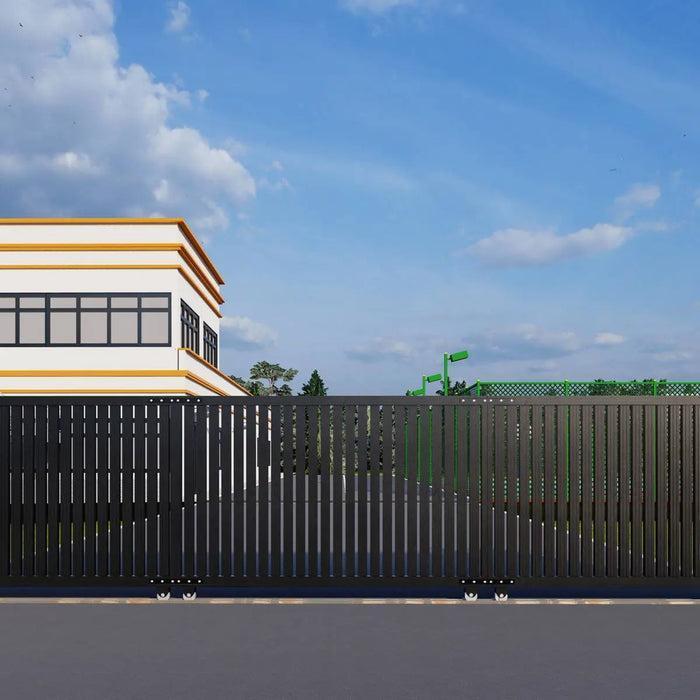
With winter close across Canada, property owners who plan a new entrance have to consider snow, ice, and frost as well as appearance. A gate that works in summer can fail in midwinter if its track fills with ice or the ground shifts. The privacy sliding wrought iron gate from TMG Industrial is a useful example, because a sliding driveway gate depends on planning for the run, the track, and the weather.
How a Gate on Rollers Works
A gate of this type rolls sideways on wheels along a track instead of swinging on hinges. The weight rides on the rollers, and a guide keeps the gate upright as it travels. This design needs no arc of clearance, which is the main reason it is chosen for steep driveways and for entrances where snow collects.
The trade-off is a long run beside the opening. The fence line must stay clear for as much length as the gate is wide, plus space for the frame that rides on the track, so a sliding driveway gate suits a property with a straight stretch of fence beside the entrance. Measure the run first, and check for trees, steps, and slopes along it.
Choosing Between Sliding and Swinging
A swing gate sweeps an arc, and snow, parked cars, or a slope can block it. A gate on rollers stays in its own lane and does not scrape the ground. On the other hand, a swing gate needs only two posts, and it has no track to clean. The choice depends on the slope of the driveway, the length of the fence line, and the amount of snow expected.
Other types exist. A cantilever gate hangs from a frame without a ground track, which avoids ice in the channel but needs a longer counterweight section, and a chain link gate costs less but offers little privacy. Each type moves the cost between the gate, the run, and the maintenance.
The In-Ground Track
The track in this model is set into the ground, level with the surface, so vehicles can cross it without a bump. A track at ground level also collects ice, sand, and leaves, and clearing it is a regular task. Good drainage under and beside the rail keeps water from freezing in the channel.
Frost is the second concern. Soil heaves in winter, and a track on poor ground can move a few millimeters, which is enough to make a heavy gate stick. A base of compacted gravel under the rail, laid straight and level, reduces that risk, and a slight slope toward a drain keeps meltwater from collecting in the channel.
Structure, Wind, and Privacy
Privacy panels turn a gate into a sail. A solid surface catches wind in a way that open pickets do not, and the force is passed to the posts, the track, and the foundation. This is why a privacy gate needs strong anchoring and why a gate of this length should not be installed on weak ground. Posts set in concrete below the frost depth resist both wind and the lifting force of freezing soil.
The gate uses a steel frame with a stabilizing extension that holds it level as it passes through the opening. Ornamental pickets above the privacy panels keep the appearance of a traditional iron gate while reducing the wind area.
- Match panel height to the height of the fence.
- Anchor posts below the frost line.
- Keep the track straight, level, and clean.
- Leave a clear run for the full width of the gate.
The list is short because most failures trace back to the same few causes. Matching the gate to the fence also removes gaps where privacy is lost, and anchoring below the frost depth keeps posts from moving in winter.
Finish, Salt, and Maintenance
Steel and ornamental iron suffer in winter, because road salt and moisture work at any scratch. A galvanized coating with baked-on powder coating provides two layers of protection. Chips should be repaired promptly, salt should be rinsed off in spring, and rollers should be checked each season for wear or loose hardware.
Rinsing is more useful than it sounds. Salt left on steel through a thaw and freeze cycle keeps the metal damp, and damp metal is where corrosion begins, even on a coated gate. A hose, a soft brush, and ten minutes each spring are enough.
Delivery and Installation
The gate arrives in two sections that bolt together into a single piece, with installation hardware included. Because of packaging limits, delivery to the door is restricted in most areas, so pickup at a store or a major hub is required. Arrange a truck or trailer long enough for the sections and a second person for lifting. Before any digging starts, locate buried utilities, and mark the post and track positions with string so the run is straight. Installation is a task for two people, and a level and a tape measure matter more than any special tool.
Safe Operation
A sliding gate carries a lot of momentum once it is moving. Keep children and pets away from the moving edge, keep the area around the gate free of stored items, never allow anyone to ride on the gate, and keep hands clear of the rollers and the track. If an automatic opener is added later, it should include sensors that stop the gate on contact. The listing does not mention a motor, so automation is a separate decision with its own power and safety requirements.
What the Gate Offers and What It Asks in Return
The strengths are reliable operation on sloped or snowy driveways, privacy without a solid wall, and a finish designed to resist rust. The limits are the long run, the track that needs attention, and the need for firm ground. A typical case is a rural property with a steep approach, where a swing gate would scrape the drift in winter. The track costs effort but keeps the entrance usable, and the owner who clears it after each storm rarely sees a stuck gate. Another case is a workshop yard where the privacy panels keep stored equipment out of view from the road.
Gate design is moving toward automation, remote access, and sensors that improve safety. A gate with a straight track and a rigid frame is easier to automate later, because a motor does not have to overcome friction. For anyone planning an entrance, TMG Industrial describes this model for residential and commercial use, and the useful questions concern the run and the track, not only the pickets.